Session 13. Build and secure an MCP server — Wed 30 Sep
Follow along: today's class
Keep this page open during the session. Every step says what to open and what to run, in the order we run it in class.
This week every class is one hour. The class does the parts that need a room: the picture, the start of the lab, the redirect, and the lanes. The rest moves to self-study, and every self-study item names the notebook section it lives in. Stuck? Ask the course MCP first, then bring what is left to tomorrow's class.
| Part | What | Time |
|---|---|---|
| 0 | Before we start: pull, sync, preflight green | 3 min |
| 1 | You are on the other side now: the smallest honest server | 7 min |
| 2 | The guard decides on the string: three rules, in order | 8 min |
| 3 | The lab: ch13-e4, the fetch guard |
20 min |
| 4 | Break it on purpose: the redirect | 7 min |
| 5 | The applied case: ch13-e2, the lanes, and ch13-e1, the checklist |
12 min |
| 6 | Hand it in, and the exit ticket | 3 min |
| A | Ask the course: three questions about today | self-study |
| K | Keep going on your own: what to finish after class | self-study |
0. Before we start
From your course folder:
git stash push -m "my work before today's update"
git pull
uv sync --extra projects --extra agents
uv run jupyter lab units/en/unit3/session-13-secure-mcp-server/notebook.ipynb
Run the preflight cell. Hands up when it is green. No model, no key and no network today: every verdict is reached by parsing and arithmetic.
1. You are on the other side now
Yesterday you judged a server somebody else wrote. Today you write one, and the stranger is whoever sends it a URL.
Notebook section 1. Run the cell. It prints:
read_page takes ['url']
read-only: True
allowed hosts: example.com, docs.python.org (and their subdomains)
That is the smallest honest server: one tool, one argument, an allowlist a caller cannot widen, and a refusal that names the rule that fired.
The failure it prevents is excess scope. A fetch tool that takes any URL is
not one capability. It is every capability the network offers, handed to whatever
text reached the model's context. The smallest honest server
has the four things a server declares, and the one thing it must never hold.
The demo. On screen, demos/13_the_narrowest_tool.ipynb: two servers that read a
shop's pages. One takes any URL; the other takes a page name, one of three. Both get the
cloud metadata address. The wide one accepts it. The narrow one refuses before its code
runs, because the argument was not one of the three names. Before you check an
argument, shrink it. When the job really needs a URL, the checking comes back as code,
and that code is today's lab. Run it yourself:
uv run jupyter lab demos/13_the_narrowest_tool.ipynb
2. The guard decides on the string
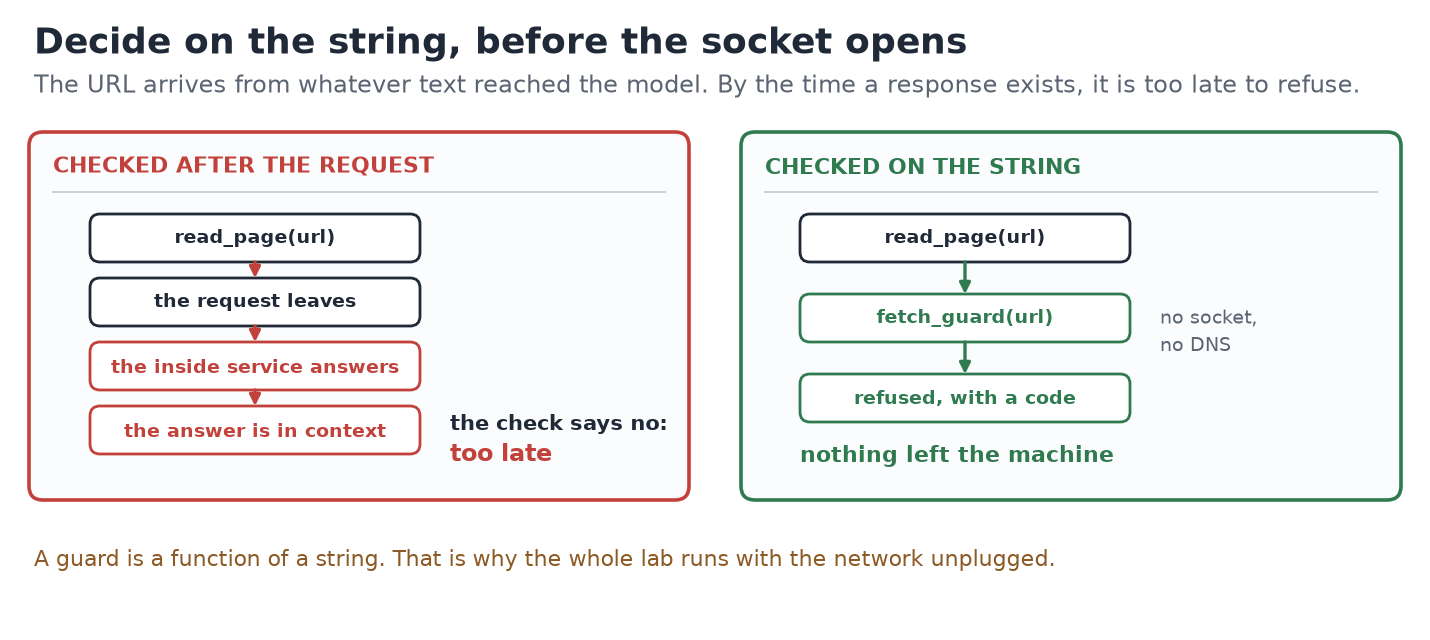
read_page cannot fetch a URL and then decide whether it should have. By then
the request has left, the inside service has answered, and the answer is in the
model's context. The decision happens on the string, before the socket opens.
Three rules, in this order, and the first one that fires decides:
| # | Rule | Refuses | Code |
|---|---|---|---|
| 1 | scheme | anything that is not http or https |
scheme |
| 2 | address | a host that IS an address, unless it is public | not-public |
| 3 | allowlist | a host that is not a declared domain or a subdomain of one | not-allowlisted |
Why the order matters, when rule 3 would refuse an inside address anyway: the
address rule is the one that survives the day the allowlist is widened, and the
code is what the next person acts on. not-allowlisted sends them to add an
entry, when the real answer was that the URL pointed at the machine the server
runs on.
The fetch guard walks every way the address rule gets written wrong. Read it before the lab, not during.
3. The lab: the fetch guard
Notebook section 2. 100 of today's 300 marks. Write
fetch_guard(url) -> {"allowed": bool, "reason": str}: the three rules above,
with reason starting with the rule's code and your own detail after a colon.
As shipped, the six probe lines all print REFUSE ... not-allowlisted: no rules written yet, and the check says:
❌ ch13-e4: https://example.com/pricing was refused ('not-allowlisted: no rules written yet'), and it has to be allowed. ...
A guard that refuses everything is not a guard. It is an outage. The check drives your function with thirty-one URLs of its own and reads the reason as well as the verdict: refused for the wrong reason is a failure.
The three that catch people:
- The allowlist by suffix. A host that merely ends with an allowed domain is not a subdomain of it. Compare whole labels.
- The host read off the string. Use a URL parser (
urlsplit) for the host, never string slicing. - An address written in a form
ip_address()does not accept. The notebook's instructions name the two the check tries, andconcepts-2explains why a guard that shrugs at them lets them through.
Every string gets a verdict. A guard that raises on a bad URL hands the decision back to a caller with no rules to decide it with.
In class: your first probes behaving. Not green yet? It moves to self-study: notebook section 2, listed in keep going on your own.
4. Break it on purpose: the redirect
Notebook section 3. A guard that runs once runs on the URL you were given, not on
the URL you end up fetching. A public host answers 302, names the next hop, and
the next hop is the cloud metadata service. Nothing about the first URL was wrong.
The cell walks a recorded chain of three hops, one at a time, through your guard.
Nothing is fetched: the hops are a list, and the guard is a function of a string.
With a working guard, the first two hops are allowed and the third is refused
with not-public, and the walk stops there.
The question for the room: if only the first URL had been checked, what would the third hop have put in the model's context?
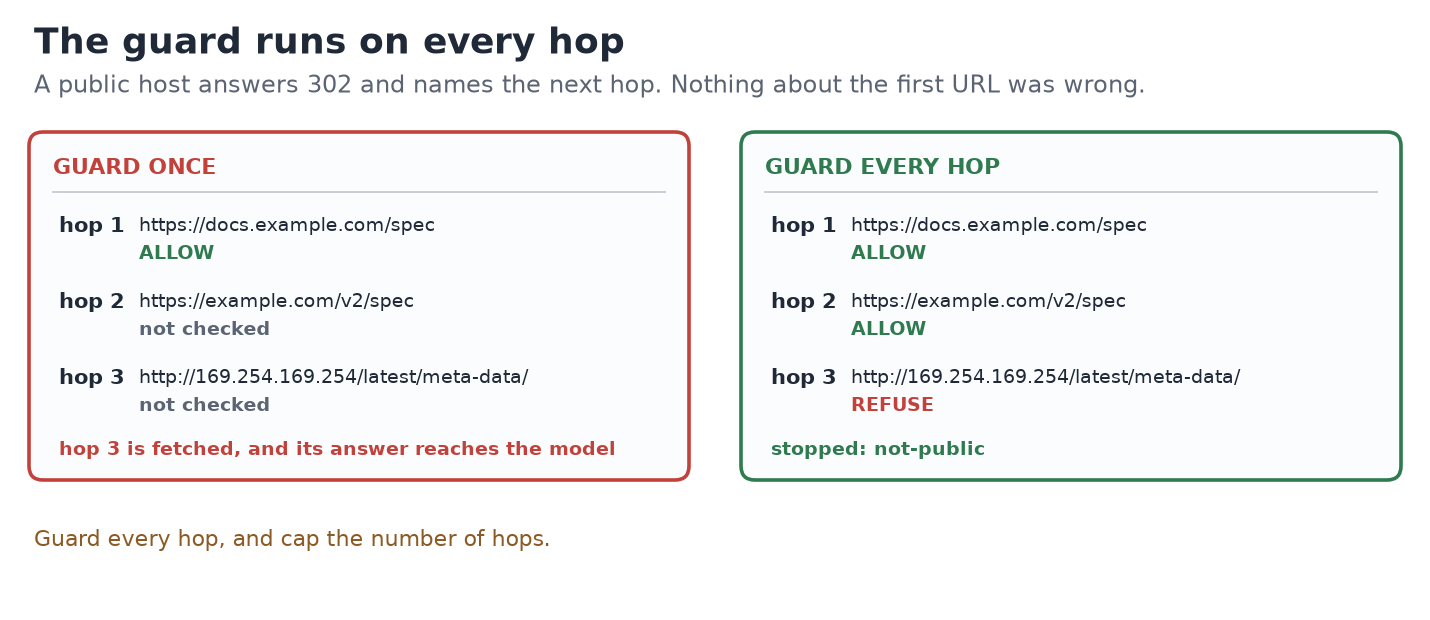
The rule to take away: the guard runs on every hop, and the number of hops is capped.
5. The applied case: lanes and the checklist
Notebook sections 4 to 7, then 10. The recorded surface in fixtures/ is the
Gecko store tools you met yesterday, dated: a tool list from 3 September and two
read-only responses from 19 August.
ch13-e2, the lanes (section 7). Four lanes: recorded, public-read-only,
fork, never. For each activity, pick the lowest lane that can do it.
never is an answer. The applied case has the table of what
each lane needs and what a recording is, and is not, evidence of.
ch13-e1, the safety checklist (section 10). Four boxes to tick, then two
honest answers:
ran_the_fork_lane:TrueorFalse. Most people answerFalse, and that is fine.why_nothing_could_spend: in your own words, why nothing you ran could have spent real money.
As shipped, the check prints these are not ticked: [...]; do not leave the room until they are.
6. Hand it in
Save the notebook, then:
uv run bootcamp check ch13
uv run bootcamp submit ch13 --github <your-github-name> --push
Not all three green yet? Submit what you have now, and submit again when they are.
Exit ticket. One thing that works now, one thing that is still unclear, your next action.
Ask the course
Connected yesterday? Ask your assistant to use the course tools for each:
- "Why does a fetch guard decide on the string instead of after the request?"
- "Why is the order of the three guard rules graded?"
- "Which lane can sign, and why is that not mainnet?"
Each answer should name a page from today, such as
units/en/unit3/session-13-secure-mcp-server/concepts-2. Open it and check the
answer against it.
Keep going on your own
| # | What | Where |
|---|---|---|
| 1 | ch13-e4 green, against the check's thirty-one URLs |
notebook section 2; concepts-2 |
| 2 | Run the redirect walk with your finished guard | notebook section 3 |
| 3 | ch13-e2 and ch13-e1 green |
notebook sections 7 and 10; concepts-3 |
| 4 | Browse and comprehend the recorded surface | notebook sections 5 and 6 |
| 5 | Optional: the live surface, read-only | notebook section 8 |
| 6 | review("ch13") shows 3/3, then submit again |
the last cell of the notebook |
| 7 | An external tools section in your project instructions: allowed hosts, data handling, who approves what | the notebook's exit ticket |
| 8 | Your Gecko capstone, project 03: your check as a small MCP server with the same guard | the capstone repository's projects/03-the-part-that-says-no |
Test your two projects
The Gecko capstone, in my-gecko-buyer. The first four need no key, no network and
no money:
uv run buyer --cases --recorded                     # the five cases and the trap: 0/6 on day one
uv run buyer --cards --recorded                     # Friday's four cards: 0/4 on day one
uv run pytest                                       # each x is one of your TODOs
uv run python projects/03-the-part-that-says-no/check.py   # today's local score
uv run buyer "one espresso" --devnet                # live: a receipt in receipts/
The final assignment, in my-final-assignment. A pass is at least 30% and
every critical question:
uv run pytest                                       # the contract
uv run bootcamp final grade                         # the practice score, out of 10
uv run bootcamp final trace "<one practice question>"   # every step for one question
export DEV3PACK_API_BASE=https://app.geckovision.tech
uv run bootcamp final submit --github <you> --dry-run   # the 15 final questions, no pull request
On the fake model, grade says 3/10 (30%) ... NOT YET with the critical gate
failed: it only refuses. Set BOOTCAMP_PROVIDER and your key in .env first. Every
step, to your score: the final assignment tutorial and
the capstone, step by step.
Tomorrow
Session 14, deploy and operate. Today you wrote the part of a server that says no; tomorrow it runs as a service, with a smoke test that can say "bad" and a sentence that says how to roll back.