Session 8. Loops and graphs — Wed 23 Sep
Loops and graphs
Wednesday, September 23, 2026 · 2h · Threads: loop + graph engineering
Outcome
You build one task three ways — a chain, the tool loop you already have, and a
capped reflection — and you fill the comparison table from counted calls rather
than from taste. Then you write the workflow down as a graph: five states, six
declared edges, and step(state, event) as the only thing that moves between
them. An event that is not legal from where you are does not move you and does
not raise. It comes back with the state unchanged and a sentence naming what was
refused. You leave able to say, about any workflow you ship, which transitions
exist — and to show that the others cannot happen.
Where this sits
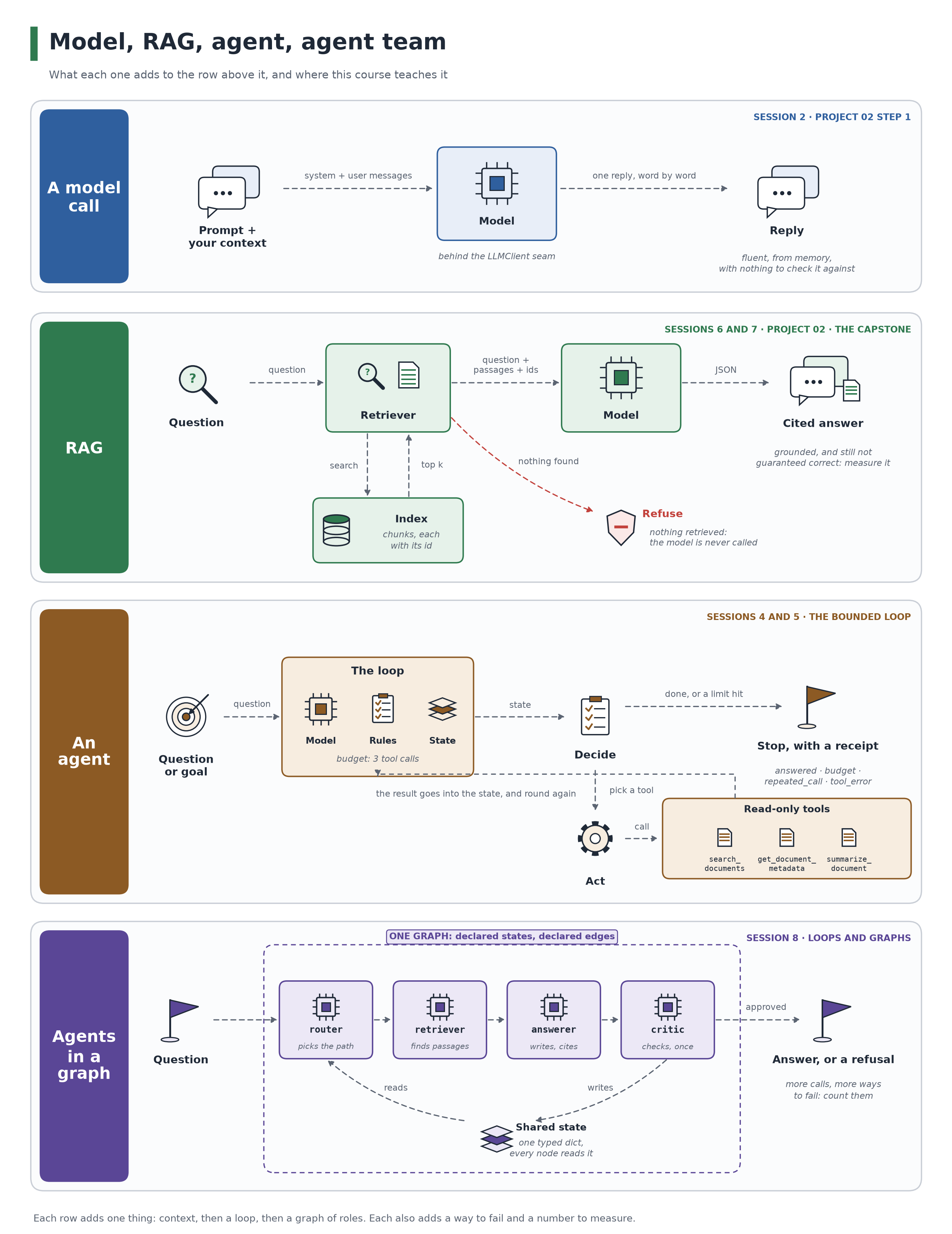
| Row | What it adds | The new way it fails | Where you met it |
|---|---|---|---|
| A model call | nothing: the prompt and your context | it answers from memory, fluently | session 2 |
| RAG | passages retrieved first, cited back | the wrong passages, cited with confidence | sessions 6, 7 |
| An agent | a loop: decide, call a tool, read the result, go again | it never stops, unless you make it | sessions 4, 5 |
| Agents in a graph | several narrow roles, one shared state, declared edges | more calls, and a transition nobody declared | today |
Each row costs more model calls than the one above it. Today you count them.
Contract and threat boundary
| Input | A question, the six-document corpus in data/corpus/, FakeLLM behind the LLMClient seam, and an event log: the outcomes a run produced, written down as {"name": "no_hits"} and driven through the machine. |
| Output | Three implementations of the same task with their measured call counts, and step(state, event) -> state over planning · retrieving · answering · refusing · done. Every state carries visited, the route so far, and rejected, empty until something is refused. |
| Budget | The chain spends 1 model call. The loop spends 1, plus at most one corrective retry. Reflection is capped at exactly one revision — 3 calls, counted, not "about 3". The state machine spends nothing: there is no model inside it. |
| Failures this session must handle | A retry storm. One edge back to the state it came from, nothing counting, so the run never ends. A partial tool failure. Two retrieval sources, one down, half the passages back — and a decision about which event that is. An invalid transition. answered arriving while the run is still retrieving: refused, unchanged, and said out loud. |
The threat is not a hostile model. It is an edge nobody drew. A workflow written
as prose has every edge and none: ask two engineers what happens after a parse
failure and you get two answers. A workflow written as if/elif has an
implicit edge for every case nobody wrote — the fall-through — and it is
reachable in production long before anybody notices it exists.
A table has no fall-through. A pair that is not in it is not an edge, so "can
this run go from refusing to answering?" has an answer you read instead of a
maintainer you have to ask.
One thing this does not buy: a legal transition can still be the wrong one. The table shows the run stayed inside the graph you drew. Whether that graph is the right graph is what session 9's evaluation is for.
Session flow
- Warm-up and diagnostic (10m). Preflight cell green on every screen. Say
out loud what
answer_questiondoes after two parse failures. Then find the line. How long that took is the diagnostic. - Contract and threat boundary (15m). The autonomy ladder, and the rule that governs it: climb a rung only when a measured failure justifies it. The contract table above, read aloud.
- Concept and live implementation (30m). The same task three ways —
chain(),answer_question,reflect_once()— withlen(llm.calls)on the screen for each. Then the five states and six edges, drawn before any code. - Guided lab (35m).
notebook.ipynb: the comparison table (ch08-e1), the graph appendix and what its trace showed (ch08-e2), thenstepand its transition table (ch08-e3). Read the event log back afterwards. - Failure injection (15m). Sections 10 and 11: add
retrieving --retry--> retrievingand watch a legal graph never end, then cap it withvisited. Then a partial tool failure, and which event you emit for it. - Evaluation and artifact receipt (10m).
review("ch08")in Jupyter, oruv run bootcamp check ch08in the terminal. Then read onerejectedsentence out loud and ask whether a colleague could act on it. - Exit ticket (5m). One thing that works, one thing that is unclear, your next action. Homework: draw the state machine of something you have shipped, failure edges included, and mark every edge nobody declared.
Evidence
This session runs unattended. Every cell works offline on FakeLLM, so the
notebook is its own arbiter:
uv run bootcamp check ch08                    # runs the notebook, prints the scorecard
uv run bootcamp submit ch08 --github <you>    # re-runs it and writes the bundle you hand in
Three checks decide it. ch08-e1 re-reads how the three implementations
behave and compares that with the table you filled in. ch08-e2 takes either a
measured comparison of the graph appendix or a stated reason you did not run it,
and refuses a blank. ch08-e3 drives your step over every state and every
event — the answer path, both refusal paths, every event fired at done, and
every pair your table never declared.
Previous: Retrieval and grounding metrics · Next: Trace and evaluate an agent