Session 8. Loops and graphs — Wed 23 Sep
Loop engineering and graph engineering
Both words describe work you do after the thing already runs. They are not two frameworks, and picking LangGraph does not put you in one of them. They are two different questions about the same system.
Loop engineering tunes one agent's cycle: decide, call a tool, read the result, go again. Your levers are the tool list, the stop conditions, the budget, what goes back into the context each turn, and what happens after a failed call. There is one actor, and you are making it terminate well.
Graph engineering decides who exists and which moves are legal. Your levers are the roles, the state they share, the edges you declare between them, and the cap on any edge that points backwards. There are several actors, and you are making the route inspectable.
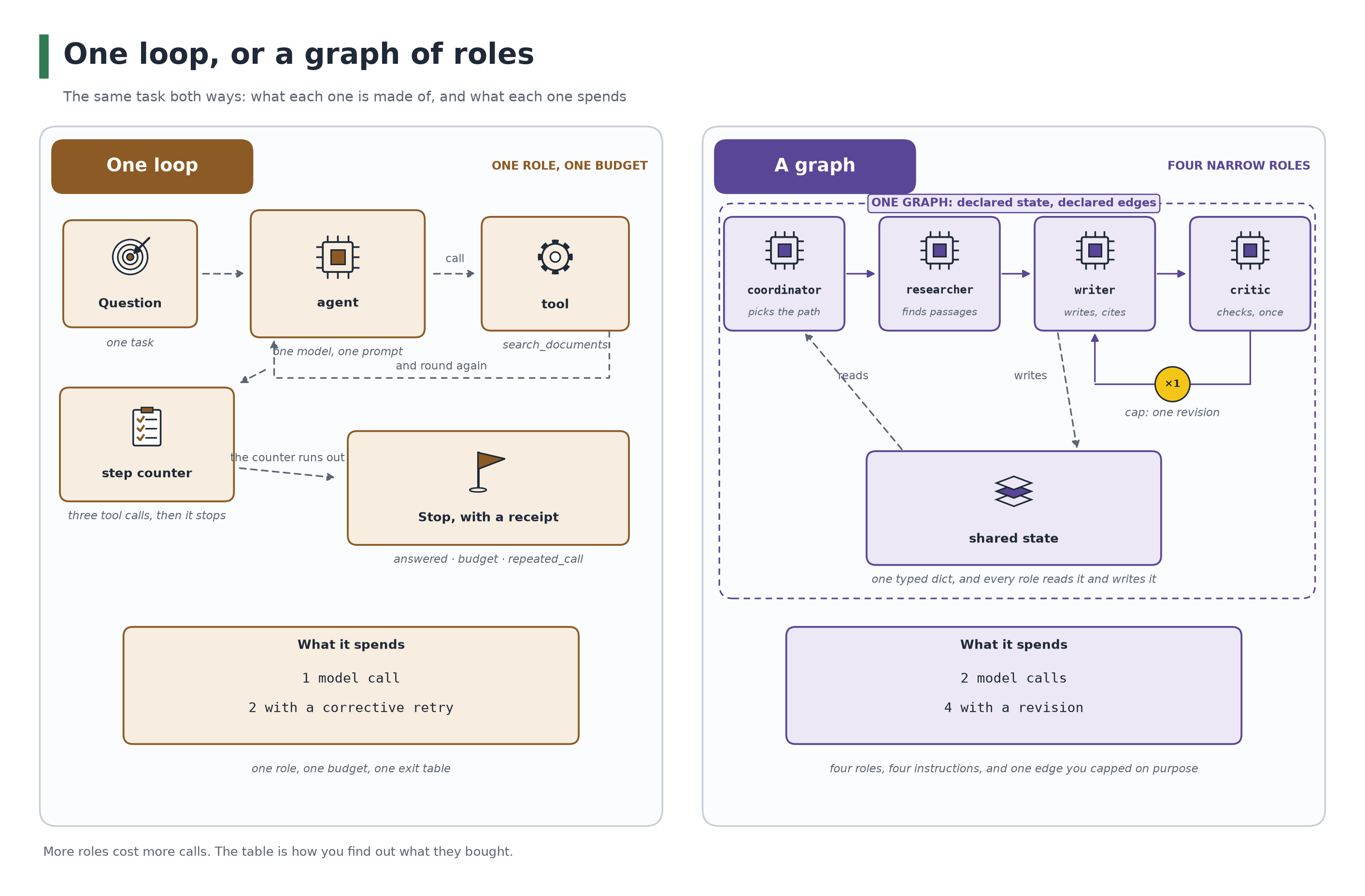
The two questions
| Loop engineering | Graph engineering | |
|---|---|---|
| The question | when does this stop, and why | who acts next, and is that move legal |
| The unit you tune | a turn | an edge |
| What goes wrong | it never stops, or it stops holding nothing | a transition nobody drew, and it is reachable |
| What you count | calls per run | calls per role |
| The evidence it works | a stop reason on every run | a route on every run |
| Where you met it | sessions 4 and 5 | today, and project 03 |
Which one your problem needs
The honest default is a loop. It is one actor, one budget and one stop reason, and most work that looks like it needs a committee does not.
| The work | Reach for | Why |
|---|---|---|
| One kind of question, one or two tools. A lookup that answers from a table. | a loop | A second role adds a model call and decides nothing. |
| An unknown number of the same step. Keep searching until something clears the floor, or the budget runs out. | a loop | The steps are alike. What you need is a counter, not a committee. |
| Latency or cost is the constraint. A user is waiting, or you run this a million times. | a loop | Every role is a call, and calls are the bill. |
| Distinct skills in sequence. Find, then read, then write, then check. | a graph | Each role gets its own prompt, its own tools and its own failure policy. |
| Different failure policies per stage. A retrieval miss should refuse; a parse failure should retry once. | a graph | In one loop these collapse into a single except. |
| Somebody will ask what happened. Support, audit, a regulator, or you in three months. | a graph | The state carries the route, so the answer is read rather than reconstructed. |
| A step waits for a person. An approval, a signature, a human review. | a graph | Waiting is a state. In a loop it is a blocked turn nobody can see. |
| Two parts have nothing to say to each other and could run at once. | a graph | Independent edges are visible, so the parallelism is a fact rather than a hope. |
What it costs, measured
Project 03 answers the same questions both ways, over the same index:
| Right company in the passages | Model calls, over 3 questions | |
|---|---|---|
| One agent, one loop | 15 of 20 | 3 |
| The team | 20 of 20 | 8 |
Read the second row twice. The extra calls did not buy better prose. They bought a mistake that stopped happening: the router picks the company before anything is retrieved, and it spends no model call to do it. It routed 17 of the 20 questions and named no company for the other 3, which is an answer too, and it was wrong zero times.
Then the project argues against itself. Give the single loop k=8 instead of
k=4 and it reaches 17 of 20 for one model call per question. Most of the gap
closes by retrieving more, not by hiring anybody. That is the number a team has to
beat, and quoting the 15 without the 17 would be the comfortable version. If your
graph cannot name what it bought against the cheapest fix, it is a loop wearing a
diagram.
Three ways people get this wrong
Multi-agent as a goal. Roles get added because the diagram looks more serious with five boxes. Every box is a call. The test is the comparison table, not the picture.
The critic nobody capped. Writer and critic will argue until something stops them. An edge that points backwards needs a number on it, and the number belongs in the state where anyone can read it. Project 03 ships that failure on purpose, in step 8, before it ships the cap.
The fall-through. A workflow written as if/elif has an implicit edge for
every case nobody wrote. A table has no fall-through: a pair that is not in it is
not an edge. That is the whole argument for writing the graph down, and it holds
whether or not you install a framework.
The graph is yours, the framework is a runner
Project 03 builds the same four roles twice, once with LangGraph and once in plain Python, and asserts the two produce the same state. That is deliberate. A framework gives you a place to declare edges, a way to draw them, and somebody else's bugs. What it does not give you is the graph. You still have to know which transitions exist, and be able to show that the others cannot happen.