Capstone: the source-grounded research assistant
The road to the capstone
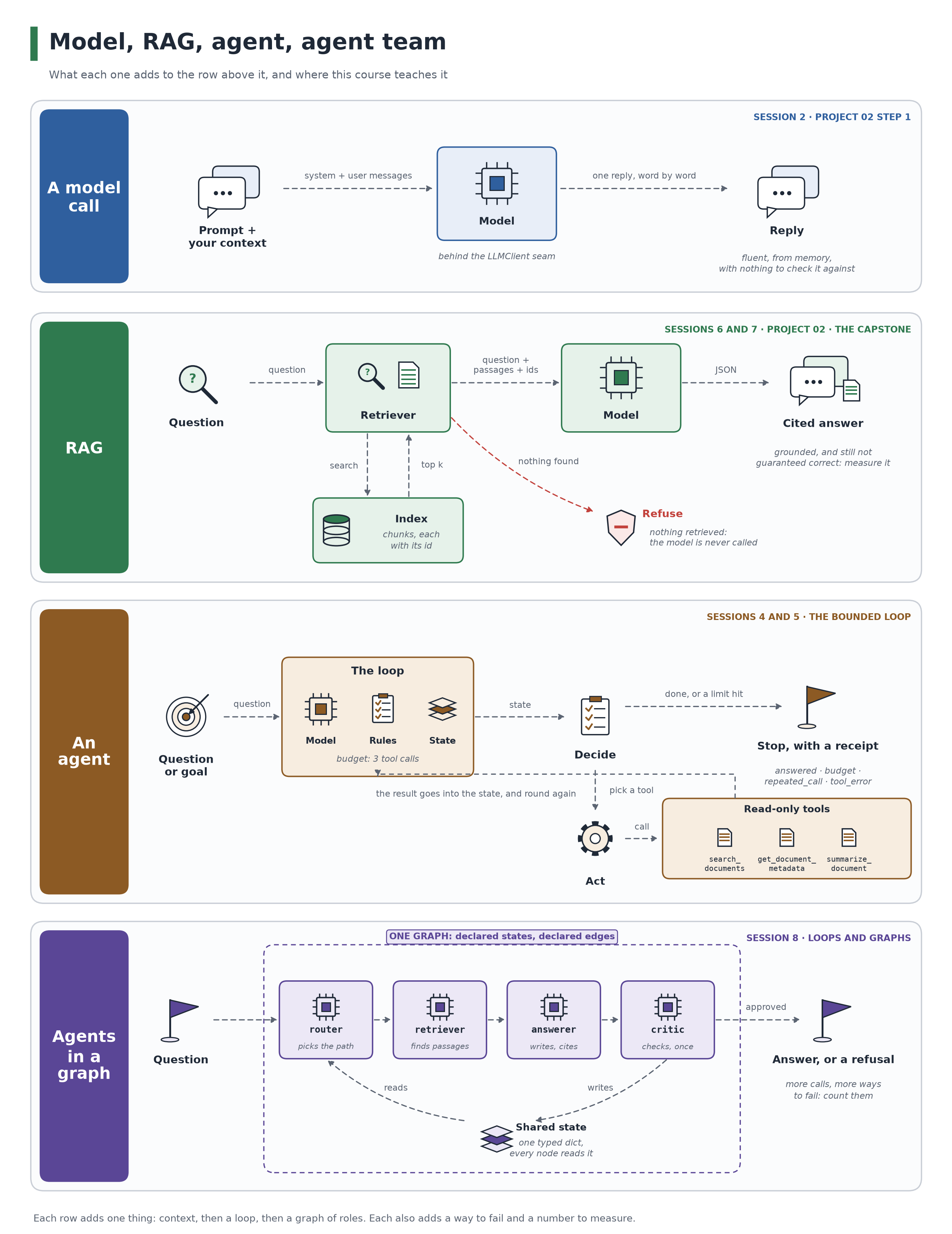
One page for the whole course: what each session gives you, and which part of the capstone it becomes. Keep it open when you plan your week.
The capstone, in one paragraph
You ship a research assistant. It answers developer questions from a small set of documents, names the document behind every claim, and says "I don't know" when the documents don't support an answer. It uses one read-only tool, comes with a skill file another assistant can load, and arrives with a test and an evaluation report whose numbers you produced. In session 15 you demo it, and then you fix a failure you did not prepare for, from your own traces.
The full brief is on the capstone page.
Three weeks, three goals
| Week | Goal |
|---|---|
| 1 | Contracts before code. An assistant, one model adapter, a typed output, a bounded tool, and a small agent loop that always stops. |
| 2 | Grounding and evidence. Retrieval, measured. The loop becomes a graph. Traces, evaluation, and your first decision record. The capstone opens. |
| 3 | Operating it. Memory with a leak test, an MCP server that says no, a deployment, and the demo. |
Fifteen sessions, one line each
| # | Session | In one line |
|---|---|---|
| 1 | Configure the assistant | Your assistant reads the repo's rules before it writes code. |
| 2 | Call a model through the adapter | Call any model through one small interface, and swap it with one setting. |
| 3 | Structured outputs | The answer comes back in a typed shape, or it is rejected. |
| 4 | Bounded tools | Tools that do only what you allow, and say no by name. |
| 5 | A deterministic mini-agent | A loop that always stops, with a receipt saying why. |
| 6 | A retrieval baseline | Find passages by the words they share, and see how that fails. |
| 7 | Retrieval and grounding metrics | Measure retrieval and answers with numbers you can defend. |
| 8 | Loops and graphs | One task as a chain, a loop and a graph, and what each one costs. |
| 9 | Trace and evaluate | Record every step, and grade the agent against a test set. |
| 10 | Skills and a decision record | A skill another assistant can load, and why you built it this way. |
| 11 | State and memory | Decide what it remembers, cap it, and prove it in code. |
| 12 | MCP architecture | Host, client and server, and every tool marked read or write. |
| 13 | A secure MCP server | Build the part of a server that says no. |
| 14 | Deploy and operate | Run the capstone as a service. |
| 15 | Defend the capstone | Demo it, then fix a failure you did not prepare for. |
Sessions 11 to 15 open in week 3.
Every requirement, and where you learn it
The four failures it must handle. Each one was taught before the capstone needs it.
| The failure | What the capstone must do | Learned in |
|---|---|---|
| A question the documents can't answer | Refuse before calling the model | 5, 6 |
| A citation retrieval never returned | Remove it, lower the confidence, flag it for a human | 3, 6 |
| An instruction hidden in a document | Treat it as data to quote, never an order to follow | 4, 13 |
| A model that never answers | Return a refusal the caller can read, not a crash | 2 |
The five checks (uv run bootcamp check cap01):
The first four pass as shipped: they run the course's reference pipeline, not your agent. The capstone guide says what judges yours.
| Check | What it reads | Taught in |
|---|---|---|
cap01-e1 |
a supported question, answered with a verified citation | 6 |
cap01-e2 |
an unsupported question, refused with zero model calls | 6 |
cap01-e3 |
a trace a reviewer can follow | 9 |
cap01-e4 |
the evaluation gate: every case passes | 9 |
cap01-e5 |
your ranked issue list, written by you | 9, and kept until 14 |
The evidence you hand in, and the session that produces each piece:
| After session | You add to the capstone |
|---|---|
| 6 | Load the documents strictly and retrieve over them. Supported questions get passages, and unsupported ones get nothing. |
| 7 | Your baseline pass rate on the golden set, plus one honest weakness of your evaluator. |
| 8 | The shape of the run (chain, loop or graph) and the model calls each one cost. |
| 9 | Tracing on, run_evals rerun, and the first failure named with the trace line that decided it. |
| 10 | A SKILL.md with a before and after pair of runs, and a decision record for step 8's choice. |
| 11 | What a session remembers, its cap, and the line naming what you refuse to store. |
| 12 | Every tool marked read or write. Only the readers stay wired to the capstone. |
| 13 | One outside source used through a recording, with where the data came from written down. |
| 14 | The hardening: the injection test, the timeout, and a regression test for your top issue, with the numbers before and after. |
| 15 | The demo, and a live diagnosis. |
Ranked issue list first, fixes second. An unfinished item you have diagnosed is worth more on demo day than a finished one you can't explain.
Start now
You can do step 6 as soon as session 6 is done. Load data/corpus/,
retrieve over it, and watch a supported question come back with passages while
an unsupported one comes back empty. That is the ground under checks 1 and 2.
The projects, and how they fit
The projects are practice on real, messy data. They are optional, never
counted, and they do not change the capstone. The capstone stays on the six
documents in data/corpus/, runs offline on the fake model, and needs no
database and no new dependency.
| Project | Practises | For capstone step |
|---|---|---|
| 01: What are customers really saying? | Embeddings and a vector database on 1,000 reviews | 6 |
| 02: What are these companies worried about? | A complete RAG on real company filings: clean, load, chunk, embed, retrieve, answer, measure | 6, 7 |
| 03: An analyst team | A graph of agents that choose a parsing tool and check its result | 8, 9 |
Projects 02 and 03 open this week.